
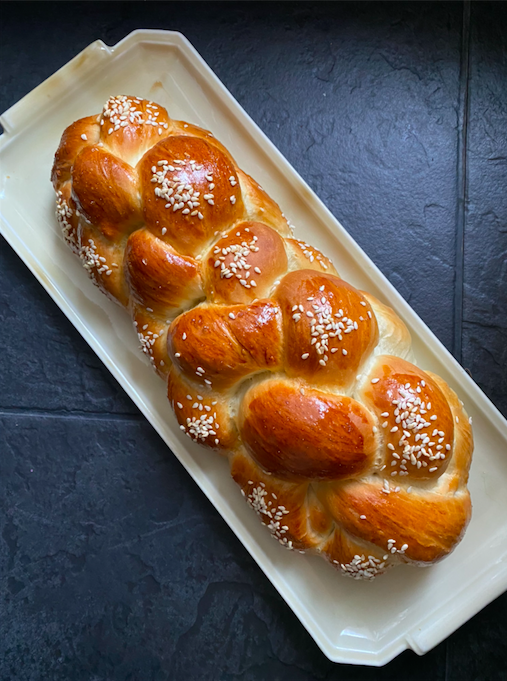
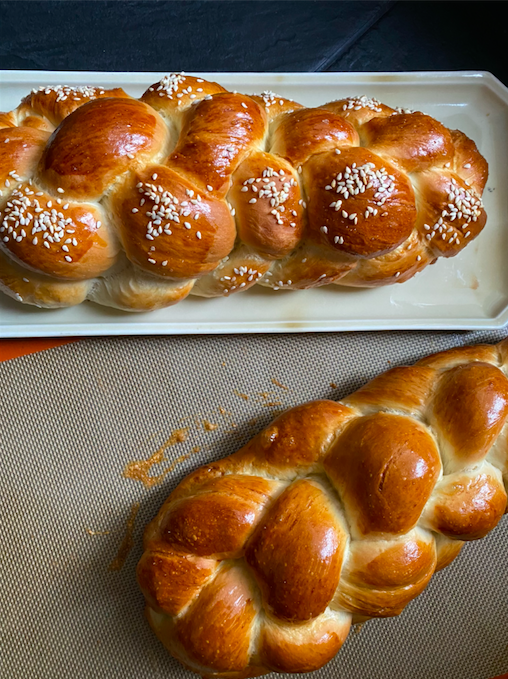
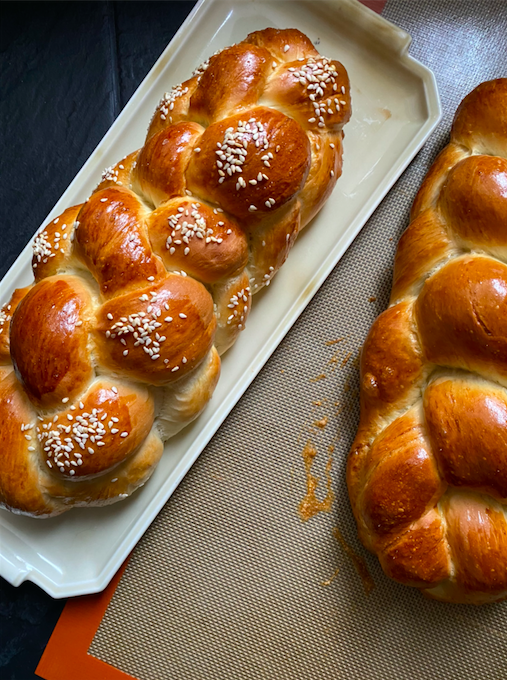
Challah breads are braided Jewish loaves traditionally placed on the Shabbat table every Friday evening. They are a cross between bread and brioche : light and airy inside, golden on the outside, and served slightly warm, they are an absolute delight.
Beyond their symbolic meaning, Hallot are part of an ancient traditional recipe passed down through Jewish families for millennia, from generation to generation. According to custom, each family has its own recipe and unique way of braiding the dough.
At first, Hallot may seem challenging to make, as they do require a bit of practice. However, with the right recipe, precise proportions, and clear instructions, you can master the various steps more easily and quickly.
Making Challah bread : my personal experience
Before sharing all my tips, let me tell you about my own experience.
A few years ago, when I first tried making homemade Challah bread, it was an absolute disaster. I wasn’t using the right ingredients (yes, I confused baking powder with yeast!), I didn’t know how to knead properly, and I couldn’t tell when the bread was fully baked… Nothing worked, and I was completely discouraged.
After that, I began experimenting with new recipes, but it still wasn’t quite right. I couldn’t get the proportions right: the dough was either too dry or too sticky, and kneading remained a struggle. I often ended up with a loaf that was edible but had a dense or dry crumb.
Everything changed when my friend Rinah shared her recipe with me. Even on my first attempt, while I was far from an expert, I noticed that the dough was much easier to knead and the steps flowed more smoothly. Everything became simpler, and after a few weeks of practice and minor adjustments, the Challah bread I baked were simply incredible—both in taste and appearance!
Everyone who tried them was impressed, and my Challah bread quickly became one of my specialties. I’m sharing this to reassure you: making soft, delicious braided loaves is absolutely achievable. You are not doomed to buy prepackaged bread forever. With this recipe, you can succeed, as long as you carefully follow the instructions and respect each step of the process.
⁉️ How to Make the Best Challah bread in the world ?
To start, I recommend taking just three minutes to read this detailed FAQ I’ve prepared especially for you. It contains valuable tips and all my tricks to avoid common beginner mistakes. Absorb these simple recommendations, and you’ll save time and avoid countless failed attempts.
Planning Your Shabbat Menu
Challah bread is the centerpiece of a Jewish Shabbat or holiday table. Here are some ideas to help you create an exceptional menu.
Kémias (Appetizers): Start your meal with delicious small dishes—fresh salads, cooked salads, marinated vegetables, and more. I’ve compiled over 80 ideas for kémias to serve on your table.
Main Courses: These are the classic dishes I usually serve when hosting at home:
- Couscous with Beef Meatballs: A true timeless classic.
- Honey and Mustard Roast Chicken: The simplest and quickest recipe for when you’re short on time.
- Beef with Carrots (No Wine): A foolproof, universally loved dish.
- Meatballs in Tomato Sauce: Another classic you can never get tired of.
- Sephardic-Style Chicken with Olives: Rich, deep flavors for an iconic dish.
Desserts: If you’re serving meat, choose a parve dessert (dairy-free) to respect kosher rules. I recommend either this incredible chocolate mousse or a classic apple cake.
Challah bread : the recipe
Ingredients
Be careful: making Hallot requires precision. Make sure to use all the ingredients listed below.
- 1 kg (8 cups) all-purpose flour
- 1 cube fresh yeast (42 g / 1.5 oz)
- 75 g (1/3 cup) sugar
- 10 g (2 tsp) salt
- 100 g (7 tbsp) olive oil
- 1 egg (for the dough)
- 1 egg (for the egg wash)
- Sesame seeds for topping
Essential Equipment for Making Hallot
Pour réaliser de délicieuses Hallot, il est important d’avoir le bon équipement. Voici la liste des produits que j’utilise et que je vous recommande de vous procurer.
To bake delicious Hallot, having the right tools is crucial. Here’s a list of items I use and recommend:
- Large Mixing Bowl: Whether you’re making Hallot with 1 or 2 kg of flour, it’s important to have a bowl large enough for the dough to rise. I use a specific bowl that works perfectly, and there’s also a version with a lid, which is very convenient for the rising process.
- Kitchen Scale: Essential for accurately weighing most ingredients.
- Measuring Cup: Needed to dissolve the yeast and measure the water for the dough. I use a Pyrex measuring cup.
- Baking Sheet: Useful for placing your braided Hallot before baking. After the second rise, you simply put them in the oven. Tip: if you’re working with 2 kg of flour, get two baking sheets.
- Pastry Brush: For applying the egg wash to the loaves. A simple brush works perfectly.
- Stand Mixer: If you want to save time on kneading, investing in a good stand mixer is worth it. Brands like KitchenAid or Kenwood are excellent, but there are also more affordable, high-quality options.
Instructions
- In a measuring cup, dissolve the fresh yeast in 250 ml (1 cup) of warm water and let it sit for 15 minutes.
- In a large mixing bowl, combine the flour, sugar, salt, olive oil, and 1 egg.
- Add the yeast and water mixture to the bowl.
- Pour another 150 ml (2/3 cup) of warm water into the measuring cup to loosen any remaining yeast, and gradually add it to the mixing bowl.
- Mix everything by hand and knead for about 10 minutes. If the dough feels too dry, add up to 50 ml (3 tbsp) of warm water, but no more.
- Place the dough back into the bowl, cover, and let it rise in a warm, dry place or in a turned-off oven for 1 hour.
- After 1 hour, remove the dough from the bowl. Punch it down, knead for 1 minute, then divide the dough into portions according to the braid style you want.
- Braid the loaves and place them on two baking sheets. See my video below to get help for the braiding.
- Let the braided dough rise a second time in a warm, dry place or turned-off oven for 1 hour.
- Preheat your oven to 180ºC (350ºF).
- Beat 1 egg in a small bowl and brush it over the Hallot using a pastry brush. Sprinkle with sesame seeds or other seeds of your choice.
- Once the oven is preheated, bake the Hallot for 20–30 minutes, until golden brown.
Notes
- When mixing the ingredients, the dough should have a texture that is neither too dry nor too sticky. It should be firm and uniform, not sticking to your fingers, and no pieces should break off.
- If the dough feels too dry, add water in very small amounts. In my experience, it’s easier to work with dough that starts slightly dry than dough that is too sticky.
‼️ For all the tips and detailed instructions to make perfect Challah bread, check out the FAQ I created to answer all your questions.
I’m sure you’re going to love this recipe, and I can’t wait to see your results! Feel free to share your best photos or tag me on Instagram. And if you enjoyed this recipe, discover many more by visiting this page.

Challah Bread : The Best Jewish Braided Bread Recipe
Ingrédients
Instructions
-
In a measuring cup, dissolve the fresh yeast in 250 ml (1 cup) of warm water and let it sit for 15 minutes.
-
In a large mixing bowl, combine the flour, sugar, salt, olive oil, and 1 egg.
-
Add the yeast and water mixture to the bowl.
-
Pour another 150 ml (2/3 cup) of warm water into the measuring cup to loosen any remaining yeast, and gradually add it to the mixing bowl.
-
Mix everything by hand and knead for about 10 minutes. If the dough feels too dry, add up to 50 ml (3 tbsp) of warm water, but no more.
-
Place the dough back into the bowl, cover, and let it rise in a warm, dry place or in a turned-off oven for 1 hour.
-
After 1 hour, remove the dough from the bowl. Punch it down, knead for 1 minute, then divide the dough into portions according to the braid style you want.
-
Braid the loaves and place them on two baking sheets. See my video below to get help for the braiding.
-
Let the braided dough rise a second time in a warm, dry place or turned-off oven for 1 hour.
-
Preheat your oven to 180ºC (350ºF).
-
Beat 1 egg in a small bowl and brush it over the Hallot using a pastry brush. Sprinkle with sesame seeds or other seeds of your choice.
-
Once the oven is preheated, bake the Hallot for 20–30 minutes, until golden brown.


